

If you’ve smoked a variety of different cigars, you’ve probably noticed that not all cigars deliver the same experience, and a big part of that comes down to where the tobacco is grown. When comparing Dominican vs Honduran cigars, you’re really...

In the cigar world, few topics come up more often than handmade vs machine-made cigars. While both are widely available and enjoyed by smokers at every level, the way these cigars are made has a direct impact on quality, flavor, and overall performance.
Think of it like the difference between a handcrafted meal and something prepared on an assembly line. Both can be enjoyable, but the experience, and the intention behind it, can feel very different.
Today, there are two primary methods used to produce cigars. Handmade cigars rely on skilled labor and natural materials, while machine-made cigars depend on automated processes designed for efficiency and consistency.
Understanding the difference between these two approaches helps smokers make an informed decision, whether they’re looking for a reliable everyday option or a more intentional smoking experience.

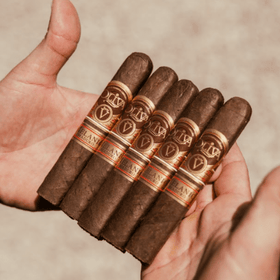
Handmade cigars are premium cigars constructed entirely by skilled cigar rollers using natural tobacco leaves. Rather than relying on automation, each cigar is built by hand, allowing individual attention to materials, construction, and balance.
Because tobacco is an agricultural product, this approach embraces natural variation. No two handmade cigars are exactly the same, and many smokers see that subtle individuality as part of the appeal. The result is a cigar that reflects craftsmanship, intent, and the character of the tobacco itself.
Hand rolled cigars are assembled entirely by skilled cigar rollers following blending decisions made by experienced master blenders. The process begins with arranging carefully selected filler leaves, which are then secured with a binder and finished with a carefully chosen cigar wrapper leaf.
Because every step is done by hand, adjustments can be made during rolling to control airflow, balance, and density. It’s similar to how a craftsman fine-tunes a tool as they work, rather than relying on fixed settings.
This hands-on approach allows handmade cigars to reflect both the skill of the cigar rollers and the intent of the blend, resulting in a more refined and consistent smoking cigar.
Handmade cigars are most commonly found in cigar shops, lounges, and online specialty cigar retailers like After Action Cigars that focus on premium tobacco products. These environments emphasize proper storage, handling, and presentation, which helps preserve tobacco quality and flavor.
There are many well know cigar brands that produce handmade cigars and they are often sold individually, in boxes, or as part of curated cigar samplers. The main focus is on high quality craftsmanship, construction, and overall smoking experience rather than mass production.
Handmade cigars are know for delivering premium cigar experiences, where the emphasis is on flavor development, construction quality, and enjoyment over time. Many smokers reserve these cigars for special occasions or moments when they want to slow down and be more present.
This reputation provides an opportunity to match up a cigar to the moment which is all about appreciating the care and skill that goes into each handmade cigar.

Machine-made cigars are produced using automated systems designed to create cigars quickly and consistently. Rather than being assembled entirely by hand, these cigars rely on machinery to shape, roll, and wrap the tobacco.
Machine-made cigars often use pre-measured tobacco and standardized materials, which allows manufacturers to produce large quantities with minimal variation. This approach prioritizes uniformity and accessibility, making machine-made cigars widely available across many retail settings.
In machine-made production, tobacco is processed so it can work efficiently with automated equipment. Tobacco is portioned into a pre-measured amount and fed into a cigar rolling machine, where pressure, density, and size are controlled mechanically.
These cigars are shaped and sealed using wrapping machines and move through the process on a conveyor belt. This method ensures repeatable construction and predictable performance, but it also limits the flexibility and variation that comes with hand rolling.
Machine-made cigars are commonly found in convenience stores, gas stations, and mass-market retail locations. They are typically packaged for easy purchase and designed for consistency and familiarity.
Some well-known machine-made cigar brands include Swisher Sweets, Black & Mild, Backwoods, and Dutch Masters. These cigars are widely distributed and designed to offer a consistent, accessible smoking option for casual or frequent use.
For many smokers, machine-made cigars serve as an entry point into the cigar world or as a convenient option when time or setting calls for something straightforward and familiar.
Machine-made cigars are known for consistency and reliability however lack the personalized touch that comes with handmade cigars. Because they are produced using standardized processes, smokers can expect similar draw, burn rate, and performance from one cigar to the next.
They are often associated with predictable construction, lower cost, faster smoking sessions, and broad availability. For many smokers, these qualities make machine-made cigars a reliable everyday smoke that fits easily into casual or on-the-go moments.

Once you understand how handmade cigars and machine-made cigars are defined, the key differences between the two become easier to recognize. These differences aren’t about which option is necessarily better, but about how materials, construction, and production methods shape the overall smoking experience.
Both styles are widely enjoyed in the cigar world, but they are designed with different priorities in mind, one focused on craftsmanship and nuance, the other on consistency and convenience.
One of the most important differences between handmade vs machine-made cigars comes down to tobacco quality and the form in which the tobacco is used.
Handmade cigars are built using all natural tobacco leaf. Individual tobacco leaves are sorted and evaluated based on texture, elasticity, and aroma. Trimmed tobacco leaves have tobacco stems removed so the cigar burns evenly and draws smoothly. This process helps the cigar retain natural oils, which play a major role in flavor development and aroma.
Machine-made cigars rely on more processed materials. In many cases, homogenized tobacco leaf is used. This material is created by breaking down tobacco into a pulp and reforming it into sheets that can be handled efficiently by machinery. This allows for uniformity but reduces variation in flavor and texture.
The wrapper plays a significant role in both appearance and flavor. In handmade cigars, the wrapper is selected for texture, elasticity, and how well it complements the binder and filler, helping shape the overall balance of the cigar.
Construction is another area where key differences appear.
Handmade cigars are hand rolled by skilled cigar rollers, who adjust how the filler is placed to control airflow and density. Because of this, handmade cigars often burn slowly, hold ash better, and maintain a more consistent burn throughout the smoke.
Machine-made cigars rely on standardized production. Tobacco is portioned into a pre-measured amount and fed into machines that shape and wrap the cigar mechanically. This ensures repeatable construction, but it also explains why machine-made cigars tend to burn faster and feel more uniform from one cigar to the next.
The smoking experience is where you'll notice the biggest difference.
Handmade cigars are known for flavor development that progresses as the cigar is smoked. Because they use whole tobacco leaves and preserve natural oils, flavors tend to evolve gradually, creating a layered taste that develops from start to finish.
Machine-made cigars prioritize consistency. Their flavor profile is usually steady throughout, offering a predictable and enjoyable smoke without much variation. For smokers who value familiarity and ease, this reliability supports everyday enjoyment, especially when time is limited.

Another major distinction between handmade vs machine-made cigars is the type of filler used.
Long filler cigars use whole tobacco leaves that run the entire length of the cigar. This allows for better airflow, a smoother draw, and helps the cigar retain moisture while it burns. Long filler tobacco also contributes to a slower burn rate and improved structure.
By contrast, short filler, also known as short fillers, is made from tobacco scraps, scrap tobacco, or chopped pieces left over from production. These short filler tobaccos are easier to measure and are commonly used in machine-made cigars. Short filler runs help ensure uniformity, but they typically burn faster and deliver less complexity.
In handmade cigars, long filler is carefully and thoughtfully arranged by hand. Rollers align the leaves to promote airflow and balance, helping the cigar smoke evenly and maintain a steady draw.
This attention to detail contributes to a smoother, more refined experience and supports the premium feel many smokers associate with premium handmade cigars.
Machine-made cigars rely heavily on short filler because it works efficiently with automated systems. Tobacco is chopped, blended, and distributed in a consistent way so machines can roll cigars quickly and accurately.
This method supports consistency and makes machine-made cigars a dependable choice for smokers who value predictability and convenience.
When comparing the benefits and drawbacks of cigars made by hand versus machine, the trade-offs become pretty evident.
Handmade cigars offer deeper flavor development, natural construction, and a smoking experience that unfolds as the cigar burns. Because they are built by human hands rather than machines, no two handmade cigars are exactly the same. That variability isn’t a flaw, it’s part of what makes them special. Each cigar reflects the decisions of the rollers, the character of the tobacco, and the moment it was made.
Machine-made cigars provide consistency, reliability, and ease of use. Their drawback is limited complexity, as efficiency and uniformity take priority over craftsmanship. That said, choosing a machine-made cigar is not a bad idea, it simply serves a completely different purpose.
Neither option is necessarily better or worse. Each exists to meet different preferences and smoking situations.

Choosing between handmade vs machine-made cigars comes down to personal preference and intent.
If you enjoy slowing down, noticing flavor transitions, and engaging with the cigar from start to finish, handmade cigars is what you're after. If you value consistency, convenience, and a predictable reliable smoke, machine-made cigars might make the most sense.
Cost, time, and setting all play a role in making an informed decision. What matters most is choosing the cigar that fits the moment.
At After Action Cigars, we see cigars as more than something to light up. For us, a good cigar is an opportunity to slow down, step away from the noise, and be present, whether that’s during a quiet moment alone or time spent connecting with others.
That’s why our preferred choice tends to be premium handmade cigars when time allows. Hand rolled construction, long filler tobacco, and natural leaf create a smoking experience that unfolds gradually, encouraging patience and attention. These are the cigars we reach for when the goal is intention, not speed.
At the same time, machine-made cigars absolutely have a place. Not every moment calls for a long smoke, and their consistency and accessibility support everyday enjoyment without complication.
If you’ve smoked a variety of different cigars, you’ve probably noticed that not all cigars deliver the same experience, and a big part of that comes down to where the tobacco is grown. When comparing Dominican vs Honduran cigars, you’re really...

If you’ve spent time exploring premium cigars, you’ve probably either been curious about or even run into the comparison between Honduran and Nicaraguan cigars. While both countries produce high-quality cigars, the experience they deliver can feel completely different once you...

You’ve probably heard the debate between Dominican and Nicaraguan cigars. While both countries produce some of the most well-made cigars in the world, they offer very different cigar smoking experiences. At a glance, Dominican cigars are known for their smooth,...